
Repair what holds it back.
Master it for release.
From a Suno export to your own session — clearer detail, a balanced tonal curve out of the box, and release loudness without the crush.
Repair and mastering typically take 3–6 minutes per track. You audition the preview first — the final master follows when processing completes.
What MixLens actually does.
MixLens runs on dedicated server infrastructure with GPU acceleration. It operates in the spectral domain with full frequency-by-frequency processing, psychoacoustic modeling, and a mastering chain that makes decisions based on what it actually hears in your audio, not from a preset table.
How MixLens works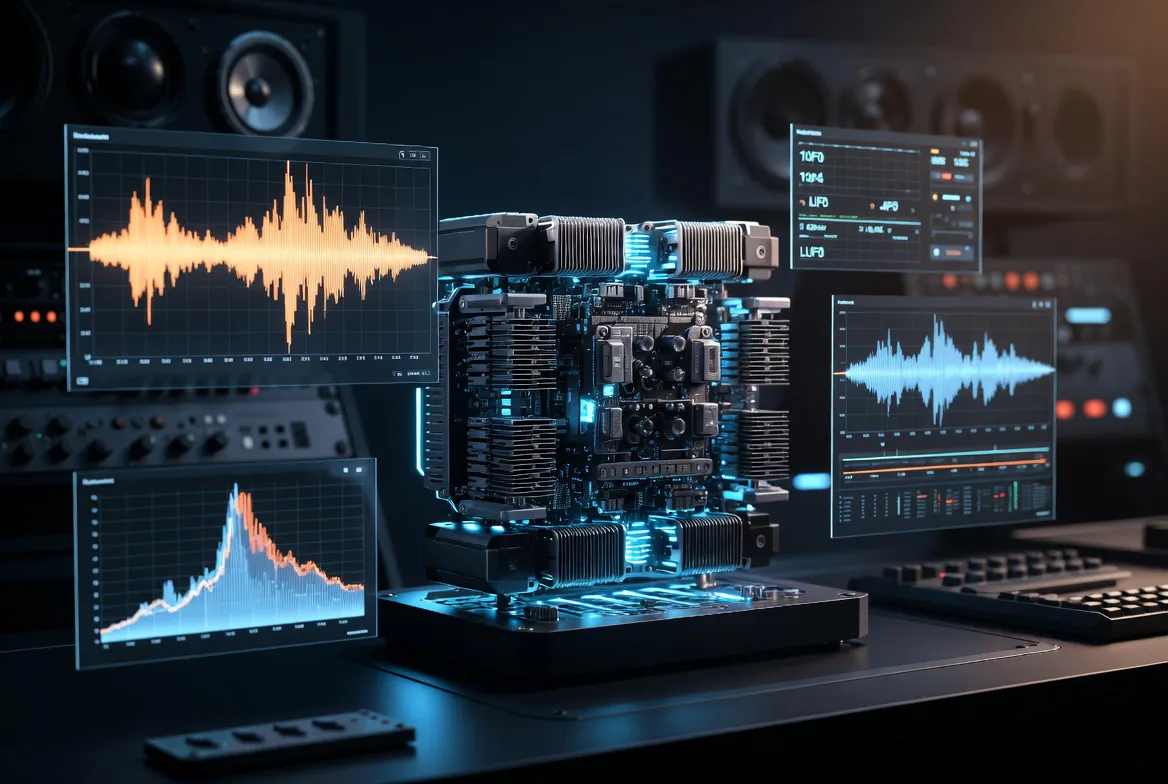 Dedicated GPU infrastructure / full spectral-domain processing
Before anything touches your audio
10-DIMENSION PROFILEThe weak spots in a raw track,
treated before loudness.
AI codecs leave artifacts no tool can fully erase. MixLens measurably reduces them, then balances the mix so mastering has something solid to push.
AI hiss and shimmer
Reduces metallic top-end haze before mastering pushes level.
Muddy low-mids
Controls 150-500Hz buildup so kick, bass, and vocals keep separation.
Harsh presence
Tames brittle upper mids without collapsing detail.
Weak bass body
Adds controlled density and gain without giving up the true-peak ceiling.
Codec top-end hashing
Uses restoration and HF management to make cymbals and air less synthetic.
Quiet release level
Masters toward release loudness while protecting crest and fold-down.
Streaming-loud.
Transients intact.
Most tools buy loudness at the limiter and pay for it in flattened drums and pumping. MixLens does the work earlier in the chain, so a typical mix gains around 4 LU of perceived loudness while its transients barely move.
Measured on a full-length master through the release chain (−13.8 → −9.9 LUFS integrated). Every master ships with its own report — preview the metrics before a credit is spent.
More than a render button.
Every account ships with working studio tools — meter the master, analyze any track, or fine-tune the result by ear.
Credit packs or a monthly plan.
One credit masters one track. Preview every master and inspect its metrics before a credit is spent at download.
Preview, A/B, and download release-ready masters per credit.
Questions, answered.
Yes. The chain detects AI-generated audio and runs restoration before mastering. It will not erase every codec artifact, but clarity and fidelity improve measurably.
Yes. Analysis decides whether repair is needed — a clean mix skips restoration and goes straight to the mastering chain.
No. The web flow is built for preview, A/B comparison, and then download.
A release WAV render with MixLens quality metrics including LUFS and true peak.
No. Genre guides the final presentation. The Subtle, Balanced, and Unhinged presets adjust tone and gain.